Art therapy sits in the space where words falter and images begin to speak. In practice, it is not a set of coloring exercises or a distraction from the “real” work. It is the work. A clinician trained in both psychology and the visual arts uses materials, process, and relationship to help clients externalize inner experience and metabolize it safely. When it goes well, clients do not simply talk about change, they can see it, touch it, and revise it.
What art does that talk often cannot
Language is a superb tool for organizing thought, but traumatic memory and early attachment experience are notoriously nonverbal. They show up somatically, in images and sensations, in fragments and flash states. Drawing, shaping clay, tearing paper, or building a simple assemblage engages procedural and sensory memory systems that verbal insight rarely reaches. A client who spends ten minutes selecting a shade of blue or resisting the messiness of charcoal reveals regulation patterns, control strategies, and tolerances that tend to stay hidden in conversation.
This shift from telling to doing also rebalances power. When a client chooses materials, pace, and distance from the work, the therapy becomes a collaboration. The image can hold ambivalence, testing, or aggression without escalating interpersonal tension. A figure on paper can be pushed, amended, crossed out, or protected in ways that are physically safe and psychologically potent. In my experience, this containment is vital in trauma therapy, where approach and avoidance oscillate. The artwork becomes a third thing in the room, a shared focus that reduces the heat of eye contact while keeping connection alive.
The nervous system angle
Neuroscience does not equal therapy, but it can illuminate practice. Art making recruits bilateral motor activity, patterned repetition, and sensory modulation. These are ingredients for downshifting hyperarousal and waking up hypoarousal. Think of the cadence of brushstrokes, the rhythmic roll of ink across paper, or the weight of clay in the palms. With guidance, clients learn to titrate stimulation using the properties of materials. Soft pastels and watercolors tend to invite fluidity and can help loosen rigid control. Graphite and fine pens enable precision and can stabilize someone who feels scattered. Textured collage papers and fabric offer tactile grounding for clients who are dissociated.
Proper pacing matters. I often begin with structured, time-limited prompts to establish predictability, then open the frame as tolerance grows. Breathing naturally slows when hands find a steady rhythm. Conversely, faster mark making can mobilize a shut down system. Matching the material to the moment is a clinical decision, not a craft preference.
How theory holds the process
Art therapy is not a theoretical orphan. It draws from and enriches several streams of psychotherapy. The best fit depends on the client’s needs and the stage of treatment.
Psychodynamic therapy provides a lens for the symbolic life of images and the transferential climate around making. The way a client approaches a blank page often mirrors early relational patterns. Does the client freeze, attack the page, make a tiny drawing in a corner, or cover it entirely? Interpretations come slowly and provisionally. The priority is curiosity about what the image does in the client’s internal world, not what the clinician believes it means. Over time, recurrent motifs can constellate a personal mythology that makes sense of symptoms.
Internal Family Systems is a natural partner for creative work. Parts show up well in visual form. Instead of debating a perfectionistic protector, a client might draw it as a sharp graphite tower, then add the anxious child it guards as a small pastel figure. Moving elements on the page allows negotiation and distance that internal dialogue alone may not achieve. I often invite clients to give each part a color, a shape, and a line quality, then experiment with how those parts can coexist in a single composition without one obliterating the others. The artwork provides immediate feedback about blending, polarization, and Self energy.
In trauma therapy, the sensori-motor dimension of art is both boon and risk. It can access implicit memory quickly. That power requires strong scaffolding. I work with phased treatment: stabilization first, then carefully titrated processing, then integration. For example, a client who survived a car accident might begin by making a resource image that evokes competence and safety, perhaps a charcoal drawing of a trusted aunt’s kitchen table. Only later do we approach the crash scene, and even then we work in slices. The client might sketch the road without the car, or collage textures that suggest rain rather than depict the body. Pendulation between activation and calm is visible in the sequence of images, which becomes a map of progress.
Eating disorder therapy benefits from art’s capacity to bypass intellectualization and reveal body image directly. Clay torso sculptures, body tracing with chalk, or a collage of “food rules” externalize the disorder’s voice. Clients often discover that the harsh inner critic is easier to confront on paper than in the mirror. Art also helps metabolize shame. A burnt sienna smear out of bounds becomes a chance to practice repair. Materials tolerate mess, and clients learn that they can too. Multidisciplinary coordination is essential. I check in with dietitians and physicians to keep the art work aligned with medical safety and meal plan goals. Art can support exposures to “fear foods” by designing place settings or illustrating a sensory map of a first bite, but it should never become a ritualized substitute that fortifies avoidance.
What a session looks like
Most sessions follow a loose arc. We ground with a brief check-in, then select a prompt or revisit an ongoing series. I rarely prescribe content, but I do shape the process. A few minutes of silent making allows the parasympathetic system to come online. After, we look together. I ask the client to introduce the piece. What parts feel alive, what parts feel distant. Where does the eye go first. I might mirror an observation about edge, density, or white space, then wait. Clients often surprise themselves with the associations that emerge.
Not every session produces a “finished” image. Sometimes the work is an experiment with opacity in watercolor, or a safe exploration of ripping and mending paper. The point is not art that hangs on a wall. It is the experience of shaping something, meeting one’s own mark without judgment, and learning from it.
Materials that pull their weight
A small, well chosen set of tools can carry a long way. The goal is to offer range without overwhelming choice. For outpatient work, I keep a portable kit that fits on a rolling cart. It travels between office and group room and can transform any space into a studio within minutes.
- Heavy drawing paper, soft graphite pencils, oil pastels, watercolor set with large and small brushes, air dry clay, a selection of collage papers with varying textures, child safe scissors, acid free glue sticks
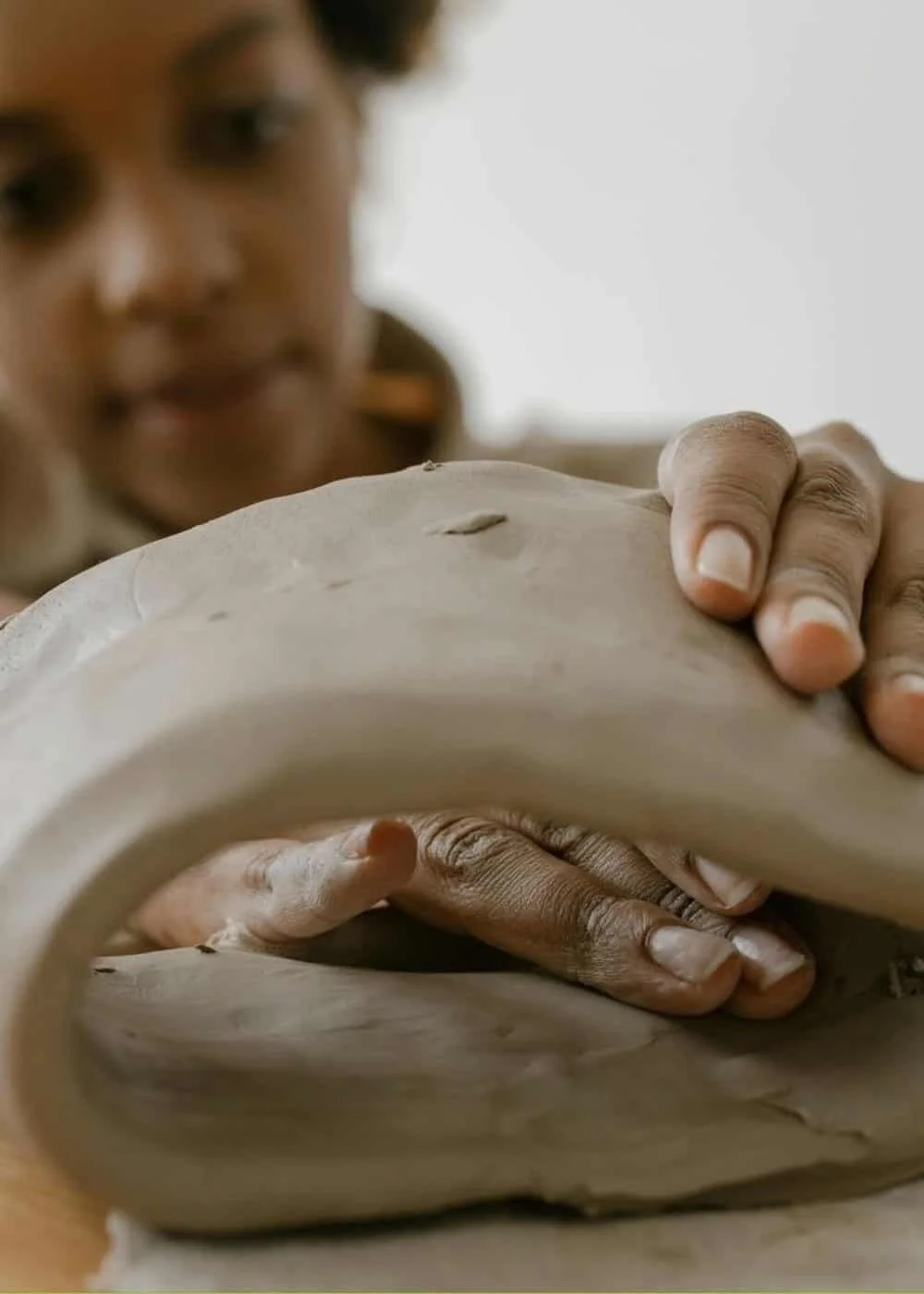
Each material has a temperament. Oil pastels layer and resist, creating vibrant transitions. Watercolor reveals how much pressure is too much. Clay records fingerprints and invites repair after rupture. Even glue teaches patience while it sets. A good clinical question is always, what quality of experience does this material invite, and what does my client need right now.
Techniques I return to
The scribble dialogue, a classic exercise, helps with parts work. The client makes a quick scribble with their nondominant hand, then responds with the dominant hand. The two scribbles begin to converse, often revealing contrast between a vulnerable voice and a managerial voice. Because there are no images to get “right,” perfectionism quiets. I have seen clients discover that a tight black knot softens when a wavering teal line crosses it gently.
Timeline collage is excellent for trauma therapy. Rather than a linear sequence of events, I invite clients to create islands of time. Each island holds a piece of experience. Arrows, bridges, or rivers can connect them. We can approach a painful island from the safety of another, adding resources around it before we step closer.
Mask making draws out social roles and defenses. Clients design an outside face and an inside face, then hold them up to a https://penzu.com/p/f2af22c22e2e152d mirror. The gap teaches more than any lecture on persona. In eating disorder work, clients sometimes realize that the “together” mask is exhausting, and they can experiment with letting some color from the inside leak to the outside.
Body mapping blends psychoeducation with image making. Clients trace an outline of their body on large paper and color where different emotions live. Many notice that anger sits in the throat as a hard red band, grief pools in the sternum as a blue weight, and anxiety skitters in the hands. This becomes a reference for regulation strategies. If fear lives in the calves, can walking or stamping help.
Containers and envelopes are small but potent. After a difficult piece emerges, we might create a sleeve or a box where it will live until next session. That physical boundary models mental compartmentalization that is adaptive rather than avoidant.
Two brief vignettes
A middle aged nurse came for trauma treatment after a series of pandemic losses and an assault on the job. She was eloquent and disconnected from her body. In early sessions she drew tight, architectural diagrams of her days, all straight lines and bulletproof boxes. We shifted to watercolor. The first time she allowed paint to bleed, she burst into tears, then laughed at the surprise of feeling. Over three months her images moved from rigid grids to loose, layered landscapes with visible mistakes that she learned to call “changes.” She reported fewer nightmares. She tacked a small watercolor by her nightstand and said it reminded her that softness is allowed.
A college athlete in eating disorder therapy arrived guarded and furious about meal plans. She scoffed at art. We did not force it. In session four, she chose clay and shaped an apple with the precision of a jeweler. We placed it beside a lumpy, heavy form that she titled Guilt. The visual contrast startled her. She began to make food forms and their paired emotions, then photographed them beside actual snacks during exposures with her dietitian. Twelve weeks later she said, I can feel full and not be bad. The clay apples softened from glass perfect to thumb printed.
Reading images without stealing them
Clinicians can do harm by imposing interpretations. A snake is not always a penis, a house is not always the self. The ethics of art therapy ask us to slow down, track the client’s associations, and use the image as a dialogue partner, not a Rorschach inkblot we own. Good questions sound like, If this line could speak, what would it say. Where does your body react when you look at this corner. What would this part need to feel safer. Now and then, a formal element, like the repeated use of tiny contained figures, suggests a hypothesis about early relational configurations. Even then, I bracket my excitement and test gently, expecting to be corrected.
Measuring progress you can see and feel
Outcome data in art therapy is growing but still uneven. Small randomized trials have shown reductions in PTSD symptoms and anxiety after structured arts programs, often in the range of moderate effect sizes. Clinical audits from hospital settings show shorter stays when art therapy is integrated into multidisciplinary care for mood and psychosis. In eating disorder treatment, art therapy correlates with improved engagement and reductions in dropout, which matters because continuity is a predictor of remission. I have found that pairing standardized measures like the PCL-5 or EDE-Q with visual markers keeps us honest. We might photograph a series of images over weeks and notice that color returns, scale expands, or avoidance recedes. Clients often articulate their own metrics more vividly: I moved the angry red from covering the whole page to sitting in the corner, and I can look at it.
Risks, limits, and good judgment
Art is evocative. That is the point, and the risk. Graphic trauma content can flood clients or desensitize clinicians. Ground rules help. We agree that graphic depictions of self harm or assault will be approached with parts language and containment strategies. I might invite a client to represent intensity symbolically rather than literally. A black square can hold the same charge as a razor without triggering sensory memories. If an image begins to overwhelm, we pause, step back, and orient to the room. The artwork can be covered with tissue paper while we regulate, a simple act that models titration.
Not everyone wants to make art, and consent is real. Some clients feel infantilized by markers, others fear judgment due to a punishing art teacher long ago. Offer choice and dignity. Verbal therapy remains primary for some. Still, I have learned not to underestimate the appeal of good materials. Many reluctant adults will pick up a soft pencil if you hand it to them without fanfare and ask what pressure feels like.
Cultural humility is required. Symbols carry different meanings across cultures and subcultures. The color white may signal purity in one context and mourning in another. Hair, clothing, and body imagery may have religious dimensions. Rather than a list of rules, humility looks like asking, What does this mean to you in your community. It also means sourcing materials that acknowledge skin tone diversity and different hair textures, and recognizing the cost and accessibility of supplies for clients who want to continue at home.
Working in teams, especially for eating disorders
Interdisciplinary coordination protects clients. In residential or PHP eating disorder programs, art therapists collaborate daily with psychiatrists, dietitians, nurses, and family therapists. If a client uses art to ritualize avoidance, such as drawing elaborate food logs that delay eating, we address it collectively. Art can support exposures by building a plate on paper before building it on the tray, but the team ensures that the art process does not become a loophole. Family sessions often include a shared art task, like creating a poster of ways to support me at dinner, which surfaces roles and miscommunications quickly and safely. Parents do not need to interpret their teen’s art. They do need to practice staying regulated while looking at it.
Adapting to telehealth without losing vitality
Remote art therapy took root out of necessity and has stayed because access matters. It can work. The constraints ask for creativity. Before the first telehealth session, I email a short supply list and alternatives that most households already have, like printer paper, ballpoint pens, junk mail for collage, and tape. We discuss camera placement so I can see hands and face when needed. The client photographs work and sends it securely between sessions. Co-regulation through a screen is possible if we are intentional about pace, eye contact, and mutual visibility of materials. Group tele-art sessions can use shared prompts and screen sharing for discussion, with clear agreements about what images are shown.
Training, supervision, and the long arc
Competence in art therapy requires graduate level training, supervised practice, and ongoing consultation. Many therapists trained primarily in verbal modalities seek collaboration with a board certified art therapist rather than dabbling. That choice respects both the client and the craft. Supervision often focuses on countertransference as it arises in the art. A clinician who avoids charcoal because it feels messy may also avoid clients’ aggression. The supervisor might invite the clinician to make a charcoal drawing about that avoidance before meeting the client again.
A short, practical start for non art therapists
If you are a psychotherapist curious about integrating simple creative elements without overstepping scope, there are prudent first moves.
- Offer choice of writing or drawing during check ins, keep prompts simple and resource oriented, and debrief the process rather than the product
That single shift, honoring process and choice, often invites clients into deeper self observation without triggering performance anxiety.
When the page fights back
Resistance shows up in art as clearly as in words. Perfectionism can stall the first mark. Avoidance appears as endless testing of pens. Aggression may tear paper. Rather than pathologize, I treat these as information. We might make a deliberately ugly drawing to practice tolerating imperfection, or set a timer for three minutes to outpace rumination. A client who tears paper can be invited to mend with gold tape, inspired by kintsugi, not as a cute metaphor but as a sensorimotor experience of repair. The page fights back sometimes. That is honest, and it gives us material to work with that is alive.
The quiet aftermath
Clients often report that the hours after art therapy feel different. Colors on the drive home look more saturated, or fatigue lands suddenly. I normalize this and build aftercare plans. Drink water, take a short walk, and store the artwork in a safe place. For clients in trauma therapy, I recommend a soothing object at home that connects to the studio experience, perhaps a smooth stone they held while drawing. Art therapy does not end when the session ends. The image continues to work in the background, like a good book you set down but keep thinking about.
What stays with me
Across settings and diagnoses, I keep seeing the same small miracle. People make marks, and those marks make people. The act of externalizing an inner state, even clumsily, often creates just enough distance to begin choosing rather than reacting. A young man who once drew himself as a stick figure at the edge of the page begins to take up more space. A mother who could not bear to look at red paints a tiny red door in the corner of her house drawing and smiles when she realizes she left it open.
Art therapy’s essentials are not fancy. Offer real materials. Hold a safe, curious frame. Let images speak in the client’s language. Draw from psychodynamic therapy when symbols invite depth. Use internal family systems to map and befriend parts. Respect the activation of trauma therapy and move in phases. In eating disorder therapy, coordinate with the team and protect against ritualization. Track change with eyes, hands, and measures. Accept limits. When you do, the page becomes a place where the nervous system learns something new, the story gains color and contour, and the person holding the brush recognizes themself with a little more kindness.
Name: Ruberti Counseling Services
Address: 525 S. 4th Street, Suite 367, Philadelphia, PA 19147
Phone: 215-330-5830
Website: https://www.ruberticounseling.com/
Email: [email protected]
Hours:
Monday: 9:00 AM - 5:00 PM
Tuesday: 9:00 AM - 5:00 PM
Wednesday: 9:00 AM - 5:00 PM
Thursday: 9:00 AM - 5:00 PM
Friday: Closed
Saturday: Closed
Sunday: Closed
Open-location code (plus code): WVR2+QF Philadelphia, Pennsylvania, USA
Map/listing URL: https://maps.app.goo.gl/yprwu2z4AdUtmANY8
Embed iframe:
Socials:
https://www.instagram.com/ruberticounseling/
https://www.facebook.com/p/Ruberti-Counseling-Services-100089030021280/
"@context": "https://schema.org",
"@type": "ProfessionalService",
"name": "Ruberti Counseling Services",
"url": "https://www.ruberticounseling.com/",
"telephone": "+1-215-330-5830",
"email": "[email protected]",
"address":
"@type": "PostalAddress",
"streetAddress": "525 S. 4th Street, Suite 367",
"addressLocality": "Philadelphia",
"addressRegion": "PA",
"postalCode": "19147",
"addressCountry": "US"
,
"sameAs": [
"https://www.instagram.com/ruberticounseling/",
"https://www.facebook.com/p/Ruberti-Counseling-Services-100089030021280/"
]
Ruberti Counseling Services provides LGBTQ-affirming therapy in Philadelphia for individuals, teens, transgender people, and partners seeking thoughtful, specialized care.
The practice focuses on concerns such as disordered eating, body image struggles, OCD, anxiety, trauma, and identity-related stress.
Based in Philadelphia, Ruberti Counseling Services offers in-person sessions locally and online therapy across Pennsylvania.
Clients can explore services that include art therapy, Internal Family Systems, psychodynamic therapy, ERP therapy for OCD, and trauma therapy.
The practice is designed for people who want affirming support that respects the intersections of mental health, identity, relationships, and lived experience.
People looking for a Philadelphia counselor can contact Ruberti Counseling Services at 215-330-5830 or visit https://www.ruberticounseling.com/.
The office is located at 525 S. 4th Street, Suite 367, Philadelphia, PA 19147, with nearby neighborhood access from Society Hill, Queen Village, Center City, and Old City.
A public map listing is also available for local reference and business lookup connected to the Philadelphia office.
For clients seeking LGBTQ-affirming counseling in Philadelphia with online availability across Pennsylvania, Ruberti Counseling Services offers both local access and statewide flexibility.
Popular Questions About Ruberti Counseling Services
What does Ruberti Counseling Services help with?
Ruberti Counseling Services helps with disordered eating, body image concerns, OCD, anxiety, trauma, and LGBTQ- and gender-related support needs.
Is Ruberti Counseling Services located in Philadelphia?
Yes. The practice lists its office at 525 S. 4th Street, Suite 367, Philadelphia, PA 19147.
Does Ruberti Counseling Services offer online therapy?
Yes. The website states that online therapy is available across Pennsylvania in addition to in-person therapy in Philadelphia.
What therapy approaches are offered?
The site highlights art therapy, Internal Family Systems (IFS), psychodynamic therapy, Exposure and Response Prevention (ERP) therapy, and trauma therapy.
Who does the practice serve?
The practice is geared toward LGBTQ individuals, teens, transgender folks, and their partners, while also supporting clients dealing with food, body image, trauma, and OCD-related concerns.
What neighborhoods does Ruberti Counseling Services mention near the office?
The official site references Society Hill, Queen Village, Center City, and Old City as nearby neighborhoods.
How do I contact Ruberti Counseling Services?
You can call 215-330-5830, email [email protected], visit https://www.ruberticounseling.com/, or connect on social media:
Instagram
Facebook
Landmarks Near Philadelphia, PA
Society Hill – The official site specifically says the practice offers specialized therapy in Society Hill, making this one of the clearest local reference points.Queen Village – Listed by the practice as a nearby neighborhood for the Philadelphia office.
Center City – The site references both Center City access and a Center City location context for clients traveling from central Philadelphia.
Old City – Another nearby neighborhood named directly on the official site.
South Philadelphia – The Philadelphia location page mentions serving clients from South Philadelphia and surrounding areas.
University City – Named on the location page as part of the broader Philadelphia area served by the practice.
Fishtown – Included on the official location page as part of the wider Philadelphia service reach.
Gayborhood – The location page references Philadelphia’s LGBTQ+ community and the Gayborhood as part of the city context that informs the practice’s work.
If you are looking for counseling in Philadelphia, Ruberti Counseling Services offers a Society Hill office location with online therapy available across Pennsylvania.